
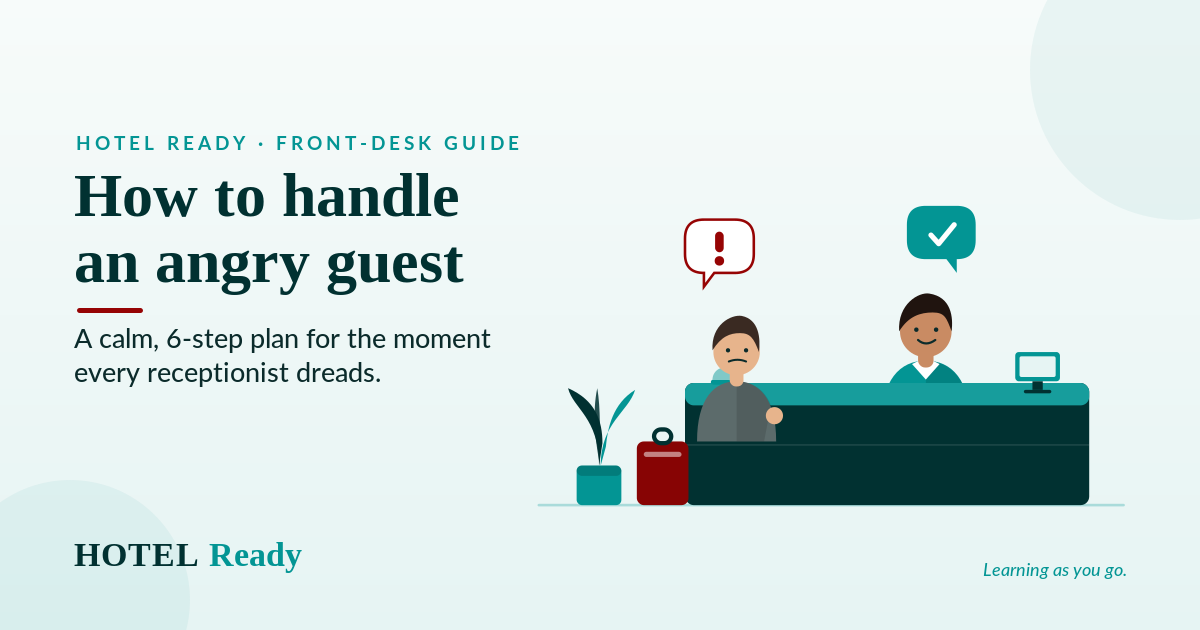
3:00 PM. The room isn't ready, the guest has been travelling since dawn, and the queue behind him is growing. He raises his voice — and every eye in the lobby turns to you.
If you work the front desk, this moment will find you. And I want you to hear it from someone who's lived it thousands of times: it's not a sign that you're bad at your job. It's simply part of the job — and like every other part of it, it's a skill you practise until it stops being scary. Here's the plan I've been teaching for years, step by step.
Why guests get angry (and why it's almost never about you)
An angry guest is almost never angry at you. They're tired, they feel cheated out of something they paid for, or they're afraid their trip is falling apart. The anger lands on you because you're the person in front of them — not because you caused it.
That difference matters. The moment you take it personally, you start defending yourself instead of solving the problem. And the calmest person in the conversation is the one who decides how it ends. Your job is to be that person.
The six steps that calm almost any guest
1. Calm yourself first
Take a slow breath before you speak. Upright posture, a low and steady voice. You don't claim calm — you show it, and within a minute the guest starts to follow your rhythm. Speak slowly, clearly, and distinctly. It works — I promise you.
2. Let them speak — all the way
Don't interrupt, don't explain, don't reach for the phone. An angry person repeats themselves until they feel heard. The fastest way to shorten a complaint is to let it come out in full — once. Nod, take notes, keep eye contact.
3. Acknowledge the feeling before the facts
Before any solution, name what the guest feels: "You've been travelling all day and this is the last thing you needed — I understand." One sincere sentence of empathy does more than three paragraphs of policy. You're not admitting fault — you're acknowledging that the frustration is real.
4. Apologise clearly — without a "but"
"I'm sorry this happened" is a complete sentence. The word "but" erases everything before it. If there's an explanation the guest genuinely needs to hear, it can come later, when they're calm — and it should sound like information, not an excuse.
5. Fix what you can, offer what you can't
Say exactly what happens next and when: "Your room will be ready in 40 minutes. In the meantime, leave your bags with me and enjoy a coffee in the lobby bar — on us." A concrete plan with a time in it beats any general apology. If the perfect solution is impossible, offer the best alternative you actually control — and never promise what you can't deliver.
6. Close the loop
This is the step most people skip — and the one guests remember. Check back: call the room after check-in, or find the guest at breakfast. A simple "Is everything alright now?" turns a complaint into proof that the hotel genuinely cares.
Researchers call it the service recovery paradox: a guest whose problem is resolved well often becomes more loyal than a guest who never had a problem at all. The complaint isn't the disaster — your response is what they'll describe in the review.
What to say — and what never to say
Phrases that help
- "Thank you for telling me — I'll take care of it personally."
- "I understand why you're upset. Let's fix it."
- "Here's what I can do right away…"
- "Give me two minutes to check and I'll get back to you."
Phrases that pour fuel on the fire
- "Calm down." (No one in history has ever calmed down at those words.)
- "That's our policy."
- "It's not my fault / that's another department."
- "You should have…" (Blame the guest and the conversation ends — badly.)
When to call a manager
Handling a complaint yourself builds trust — but some moments belong to the manager, and knowing the line is a skill in itself. Escalate when the guest asks for a manager a second time, when it involves compensation beyond your authority, or the instant someone's safety or dignity is at risk. Insults aren't part of your job description.
Hand the conversation over warmly, not defensively: introduce the guest by name, sum up the problem in one sentence so they don't have to repeat it, and stay nearby. A good handover feels like reinforcements arriving — not like being passed from desk to desk.
How teams actually get good at this
No one learns to handle an angry guest from reading — including from this article. You learn it the way you learn to swim: through practice or training, in a safe place, more times than seems reasonable. The receptionist who's met an angry guest twenty times in practice doesn't freeze on the twenty-first — even when it's the real one.
That's exactly why we built HOTEL Ready. Your team works through complaint scenarios against an AI guest that pushes back like a real one — the cold dish, the noisy neighbors, the room that isn't ready — and every conversation is scored on the same six steps, with instant, encouraging feedback. Mistakes cost nothing and no one is watching. That's exactly where confidence comes from.